

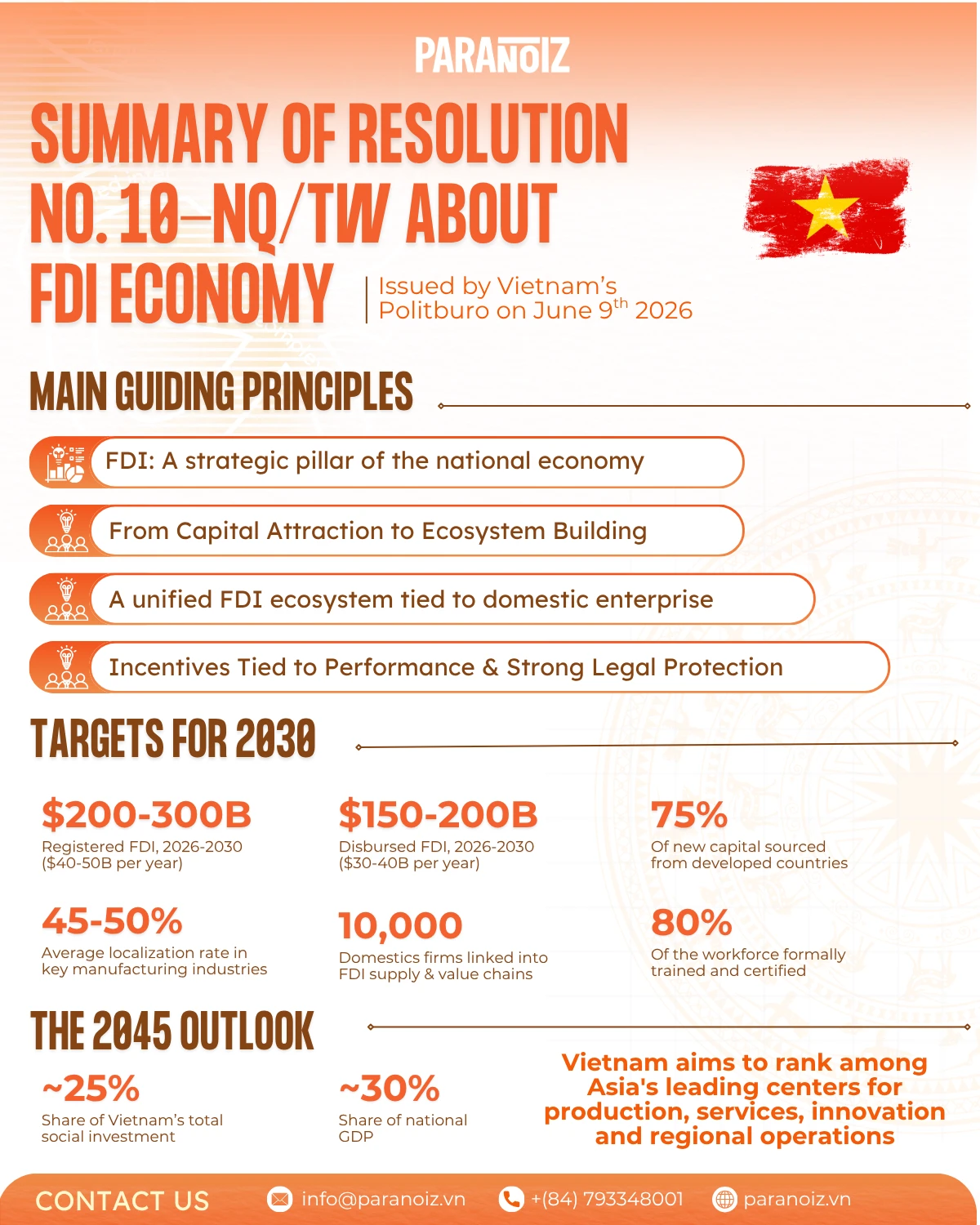
Foreign-invested enterprises have been central to Vietnam's economic transformation over the past 40 years, expanding exports, building industrial capacity and helping integrate the country into global production networks. But the resolution is candid about the limitations of that model. It points to a continued reliance on labor-, land-, resource- and energy-intensive projects, relatively low localization and domestic value added, weak linkages between foreign and local firms, and insufficient technology transfer. It also criticizes the practice of provinces competing for investment largely on the basis of capital volume rather than quality.
The resolution ties FDI policy directly to Vietnam's broader growth ambitions, which increasingly rest on science and technology, innovation, digital and green transformation, and greater strategic autonomy. In effect, Vietnam is asking a different question than it did in previous decades: not how much capital FDI can bring, but how much lasting economic capability it can build.
The policy calls for developing what it terms a national strategic investment platform, replacing the current model of provinces competing individually for projects with one organized around industry clusters, value chains and innovation ecosystems. Site selection is likely to be shaped less by land availability and labor costs alone and more by the strength of surrounding infrastructure - logistics connectivity, energy reliability, digital and data infrastructure, workforce skills, supplier networks and research capacity. A semiconductor project, for instance, cannot be assessed on industrial land alone; it depends equally on power reliability, water supply, skilled labor and a base of qualified local suppliers. The same logic increasingly applies across sectors, meaning the ecosystem surrounding an industrial park may matter more than the park itself.
By 2030, Vietnam aims for 75% of registered FDI capital to originate from developed economies with strong technology and management capabilities, and it is targeting a larger presence of Fortune Global 500 companies and multinational functions such as R&D, design, regional headquarters, treasury, procurement and shared services.
Local supply-chain integration is another pillar of the strategy. Vietnam is targeting 45–50% average localization in key industries by 2030 and aims to bring roughly 10,000 domestic firms into the supply and value chains of foreign-invested companies, including 500 to 1,000 Tier-1 suppliers. For investors, the calculus is shifting from whether they can manufacture competitively in Vietnam to whether they can build a competitive local supplier base there. Companies willing to transfer know-how and develop Vietnamese suppliers are likely to align more closely with where government policy is heading.
The resolution also signals ambitions beyond manufacturing. It specifically identifies regional headquarters, operation centers, R&D and design centers, data centers, treasury and procurement functions, and shared-service centers as targets for attraction - suggesting a gradual evolution from production base to integrated manufacturing hub to regional operating platform, particularly relevant for multinationals already established across Southeast Asia.
Perhaps the most consequential shift for investors is in how incentives will be allocated. The resolution calls for a gradual move away from traditional input-based incentives toward support linked to project performance and the fulfillment of commitments, including mechanisms for post-investment review and withdrawal of benefits where those commitments are not met. Projects that demonstrate advanced technology, environmental performance, R&D investment, workforce development, domestic supplier development, and efficient use of land, energy and resources are explicitly prioritized. The underlying question for investors is no longer simply how much capital they bring, but what they deliver and whether they follow through.
Vietnam is targeting $200 billion to $300 billion in registered FDI between 2026 and 2030, with $150 billion to $200 billion implemented, alongside deeper participation from developed-economy investors and multinational corporations. Looking to 2045, the government's ambition extends further: positioning Vietnam as a competitive regional center for production, services, innovation and regional operations, with foreign investment more closely integrated into the domestic economy and global value chains.


Vstream is a research-led media platform delivering in-depth analysis and decision-focused insights on Vietnam. Access full reports and exclusive insights curated for serious decision-makers.
Go to Vstream