
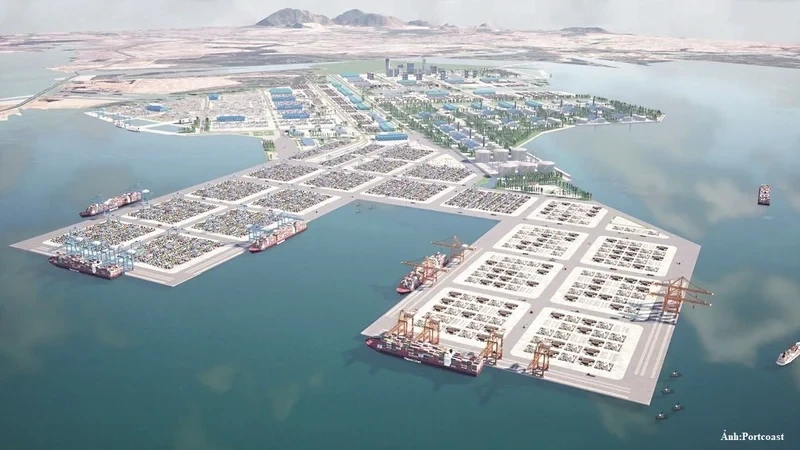
Ho Chi Minh City formally established the Cai Mep Ha Free Trade Zone on July 26, 2026. The zone occupies 4,174 hectares across Tan Phuoc and Tan Hai wards — formerly part of Ba Ria-Vung Tau province before its merger with Ho Chi Minh City in July 2026 - and is organized into eight interconnected subzones covering the full spectrum of port, logistics, industrial, and urban functions.
The eight subzones include the existing 305-hectare container terminal; the 351-hectare Cai Mep Ha Container Terminal (Subzone 2); the 780-hectare downstream Cai Mep Ha Container Terminal; a 30-hectare railway station on the Bien Hoa–Vung Tau line; a 311-hectare inland waterway port; the 272-hectare southern section of Cai Mep Industrial Park; a 906-hectare Logistics Center; and an 850-hectare industrial, urban, and service area. The zone operates under a non-tariff zone model, with customs inspection and state management functions retained under a streamlined governance structure overseen by HEPZA, the Ho Chi Minh City Export Processing and Industrial Zones Authority.
The anchor investment is already committed. Subzone 2 - the Cai Mep Ha Container Terminal - has been awarded to the Geleximco-ITC-SCIC consortium, comprising Geleximco Group, ITC Corp, and SCIC Investment, with total investment exceeding VND 50.82 trillion ($1.93 billion). The logistics center and urban-service zone remain open for domestic and international strategic investors, with detailed planning currently being finalized by the HCMC People's Committee.
The Cai Mep Ha FTZ is Vietnam's largest free trade zone by area - more than double the scale of Da Nang FTZ, which covers approximately 2,000 hectares. Its distinguishing feature is multimodal integration. Where most Vietnamese industrial and logistics zones offer road connectivity as their primary transport link, Cai Mep Ha combines deep-water port access at the Cai Mep–Thi Vai cluster, inland waterway connectivity, direct rail access via the Bien Hoa–Vung Tau line, and road links within a single non-tariff framework.
The FTZ is also designed to operate as a node within a broader southern Vietnam transport and logistics network. Its three connectivity anchors are the Cai Mep–Thi Vai deep-sea port cluster - which already handles vessels calling directly at major US and European ports without transshipment - the Can Gio International Transshipment Port currently under development with $4.96 billion in committed investment, and Long Thanh International Airport in neighboring Dong Nai, targeting commercial operations in late 2026. The combination positions the zone to capture cargo flows across sea, air, and inland waterway modes simultaneously, rather than competing on a single transport advantage.
The two largest subzones by area - the 906-hectare Logistics Center and the 850-hectare industrial-urban zone - have not yet been assigned to developers. Together they account for approximately 42% of the FTZ's total area, and they represent the investment opportunities most directly relevant to foreign logistics operators, distribution companies, and light manufacturing investors evaluating the southern Vietnam corridor.
The FTZ's three-phase development roadmap runs from Phase 1 (2026–2030), focused on activating existing infrastructure and attracting strategic investors, through Phase 2 (2030–2035), which targets full operational status for all functional zones and development of a green maritime economic ecosystem, to Phase 3 (beyond 2035), which envisions Cai Mep Ha as a major regional and international transshipment hub in Asia. Besix-Boskalis-Hateco and Sun Group have already signaled interest in the unassigned zones. For investors evaluating logistics infrastructure, port-adjacent warehousing, or manufacturing in southern Vietnam, the Cai Mep Ha FTZ provides a framework that integrates multiple transport modes, preferential customs treatment, and proximity to Long Thanh Airport within a single zone — with early-stage positioning still available in the two largest remaining subzones.

Vstream is a research-led media platform delivering in-depth analysis and decision-focused insights on Vietnam. Access full reports and exclusive insights curated for serious decision-makers.
Go to Vstream